R.I.P. Donald Lee Keller

Donald Lee Keller, a retired IRS agent and a longtime Idlewylde resident, died Jan. 19 of cancer at his son’s home in Santa Fe, N.M. He was 91.

Mr. Keller was born in Baltimore and raised in East Baltimore and Govans.

"He rode his bicycle daily until the last few months of his life," said his son, Richard L. Keller of Santa Fe.

Continue reading “R.I.P. Donald Lee Keller”

Loch Raven Trail Issue

For those wondering about the status of riding the trails at Loch Raven, here’s some information:

Website with information specifically on Loch Raven:
https://www.savetheraven.com/index.html

Discussion thread on the MORE website:
https://www.more-mtb.org/forum/showthread.php?t=17093

IMBA Website link to send a letter to City Council regarding Loch Raven:
https://secure2.convio.net/imba/site/Advocacy?cmd=display&page=UserAction&id=289

From what I found and from talking with a few people at the social, you may still ride the single track during the day. You may encounter DPW/Watershed Rangers who may or not advise you not to ride, may talk about proper trail riding, etc. You MAY NOT ride after dark.

It appears that all of the parties are working to come up with an effective solution that will allow continued riding on the single track. As more information is available I will try to post it; especially when the hearing will be held.

And if you mountain bike and do not currently belong to IMBA, please join. There’s incentives like magazine subscriptions, socks and the knowledge that you are helping to keep trails open.
https://www.imba.com/membership/choose_membership.php

Joe

Cyclists: Your bike is no longer welcome at Fort McHenry (during construction)

Fort McHenry. In spite of numerous markers around Baltimore purporting to be part of a bike trail to Fort McHenry, a cyclist traversing that trail will learn upon arrival that cyclists are no longer permitted to traverse the pathway adjacent to the river–according to some rather permanent looking signs recently erected to provide that information. According to one person purporting to be in authority, cyclists who are discovered upon that now forbidden pathway will recieve a citation.

I understand that no such injunction applies to the many persons leading dogs that continue to deposit feces and urine onto the adjacent greensward.

Continue reading “Cyclists: Your bike is no longer welcome at Fort McHenry (during construction)”

Jeff’s POV

[A comment on Streets Blog:]

I grew up in Baltimore and have lived in NYC for two years, and thus feel inclined to comment on my observations.

Baltimore ranks number 6 in the nation for car-free households, with 35.89% car-free. The public transportation in Baltimore is so bad that when I visit my friends or family for the weekend (all of whom live within the central urban core), I have to bring my bike down with me (and of course spend no less than three hours throughout the course of the weekend explaining to my parents why I am politely turning down their friendly offer to borrow an automobile – "So what if you’re drinking? You only need to drive a few miles!"). I’m sorry, did I say Public Transportation? I meant to say Poverty Transportation. Allow me to explain.

From the same country that brought you intensified class divisions based on access to health care and education comes a way to keep poor people poor through transportation! The bus system (and random rail lines that are rarely useful) is not meant to be a comfortable and convenient way to get around town. It is meant to serve as a bare minimum to allow those who cannot afford a car to get around town. After all, if only poor people are using the system, and poor people have little to no political clout, then where is the incentive to invest public money for improving the system? Obviously it’s more important for suburbanites to pay less taxes, therefore enabling them to purchase more flat-screen televisions. So in other words, in order to have comparable access to employment and education opportunities to the privileged class, one must purchase an automobile.

Yes, that’s right: People who can barely afford to feed and clothe their children are required to purchase a multi-thousand dollar product from a private vendor, and then spend hundreds of dollars per month insuring and maintaining said product. A family starts to get back on their feet financially? Oops! Timing belt broke! That will be $1000, please! In other words, the cycle of poverty continues. Economically disadvantaged individuals cannot participate in mainstream society by purchasing a $89 Metro Card as they can in more functional cities (further subsidized based on need) once a month, enabling them to use the rest of their income to feed and clothe their children, and pursue educational opportunities in order to climb out of poverty. In New York, automobile culture hurts our quality of life. In places like Baltimore, automobile culture flat-out ruins lives.

Continue reading “Jeff’s POV”

Car free

The figure given for each city is the percentage of households that do not own a car.

1. New York City, New York 55.7%
2. Newark, New Jersey 44.17%
3. Jersey City, New Jersey 40.67%
4. Washington, D.C. 36.93%
5. Hartford, Connecticut 36.14%
6. Baltimore, Maryland 35.89%
Continue reading “Car free”

We have congestion and we want more cars to make it worse?

Bumper-to-bumper traffic is America’s collective nightmare, and like the movie Groundhog Day it repeats on a daily basis.

Yet over 100 million automobile commuters each day feel like they have little option. “We put so much of our national wealth and our identity into the whole motoring thing,” says James Howard Kunstler, author of Geography of Nowhere, “that we can’t imagine doing something different.”

Anthony Downs, author of Stuck in Traffic has identified four reasons for America’s congestion problem, also applicable to most European and Asian economies: first, most of us work during the same hours of the day; second, the country’s economic success has allowed households to buy multiple cars; third, there are more people now than when most roadways were conceived; fourth, more cars means more accidents which means more delays. [Note: cyclists are not the problem here, its too many cars.]

In other words, this problem isn’t going anywhere. So the Daily Beast set out to figure out the worst of the worst.

#21, Baltimore Beltway, surrounds Baltimore
Weekly hours of bottleneck congestion: 152
Worst bottleneck: Southbound, I 70/Exit 16
Length of worst bottleneck: .46 mi
Weekly hours of congestion on worst bottleneck: 13
Speed of worst bottleneck when congested: 24.3 mph

[If my math is right going from 60mph down to 24.3mph for .46 of a mile is a delay of 40 seconds for the individual. OMG How can people live with such conditions? :p Anyway if you want to avoid the frustration… bike, it’s fun, good for you and it makes it easier on those that drive. It’s a win win solution.]
Continue reading “We have congestion and we want more cars to make it worse?”

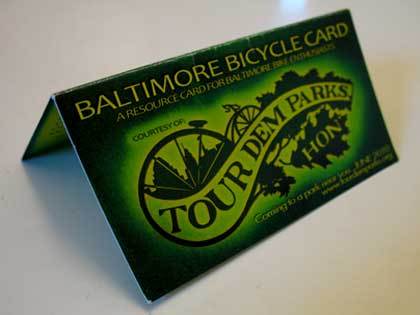
Cycling in Baltimore (the little green card)

Avid cyclists and aspiring city bike riders are recommended to keep their eyes peeled for this handy little green wallet card containing a wealth of information about bicycling in Baltimore.  The card has been distributed to area businesses and organizations.

The Resource Card For Baltimore Bike Enthusiasts has been created courtesy of Tour Dem Parks, a major fund raising event focused on supporting groups and organizations dedicated to improving Baltimore’s park system.

Below is an sample of some of the information contained in the card:

Baltimore Bicycle Organizations & Information

Baltimore Bike Club
Baltimore Spokes
Charm City Cycling
One Less Car
Velocipede

Baltimore Bicycle Shops

Baltimore Bike Works
Joe’s Bike Shop
Light Street Cycles

Continue reading “Cycling in Baltimore (the little green card)”

Police should try pedal patrols

Interesting as we reported something similar last August .

From the Baltimore Sun:

Baltimore Police Commissioner Frederick H. Bealefeld III is to be applauded for his efforts to make officers more accessible to citizens by taking them out of their cars (" City putting police back on foot patrol," Jan. 7). However, foot patrol is not the only alternative. Police officers on bikes can patrol more territory and respond more quickly than officers on foot. They can also move easily through congested areas and access alleys, parks, trails and other areas off-limits to cars. They can be swift and silent, approaching crimes in progress virtually unnoticed, often from unexpected directions and locations.

Additionally, police on bikes can engage youth, generate positive community relationships and serve as role models. They can be integrated into a wide range of operations, including community-oriented and problem-oriented policing, targeted enforcement, surveillance, public order and drug interdiction. Finally, bicycles are cost-effective and environmentally friendly and promote officer fitness.

Baltimore has many neighborhoods and business districts beyond the Inner Harbor that would benefit greatly from the approachability, versatility and mobility of bike officers. Commissioner Bealefeld is encouraged to fully explore the potential of bicycle patrols in his efforts to garner community support and enhance neighborhood safety. Allocating a portion of the $10 million federal grant to equipment and training for bike patrol would be a worthwhile investment.

Maureen Becker, Baltimore

The writer is president of the International Police Mountain Bike Association.

Continue reading “Police should try pedal patrols”

Per SHA this is bicycle safety???

Update to update: They lied the site is still up. After three months you would thing they could have gotten this fixed

Bicycle Safety Things to Know:

Did You Know?

* Children hit by cars can be killed, even when cars are moving slowly.
* Death can occur if your head is struck by a vehicle traveling as slow as 15 miles per hour.
* Children 1-2 years old are most often hurt by a backing vehicle.
* Children 3-4 years old are most often hit while crossing a street near home.
* Falls from tricycles or other play vehicles can cause serious head and brain injuries.
* Boys are much more likely than girls to be injured or killed in traffic.
* 75% of all biking related injuries requiring hospital treatment happen to children.
* 75% of biking related deaths involve injuries to the head.
* Brain injuries are preventable.

Continue reading “Per SHA this is bicycle safety???”